 AllMacWorld MAC Apps One Click Away
Download Pulsar Modular R52 Baxandall 1.0.3 for Mac free latest full version standalone setup. Pulsar Modular R52 Baxandall 2026 for MacOS is an analog-modeled audio effect plugin that recreates Peter Baxandall’s classic 1952 negative-feedback tone control circuit, including the valves and surrounding hardware emulation
Pulsar Modular R52 Baxandall 2026 for Mac Review
Pulsar Modular R52 Baxandall is an EQ and tone-shaping plugin for Mac and Windows. It is based on the Baxandall tone-control design created by Peter Baxandall and published in Wireless World in 1952. At first, R52 looks simple. You get Bass and Treble controls, along with several other settings. But the plugin is designed to do more than simply increase or reduce bass and treble. You can also download reFX Nexus for MacOS
Pulsar Modular has recreated the way the original circuit worked, including the valve stage and other parts of the original design. This gives R52 a different character from a standard digital EQ. The 1952 version uses an SP61 valve. R52 also includes a later 1957 version that uses an ECC81 valve. There is also a 1957 ALT version, which combines the 1957 design with the SP61 valve.
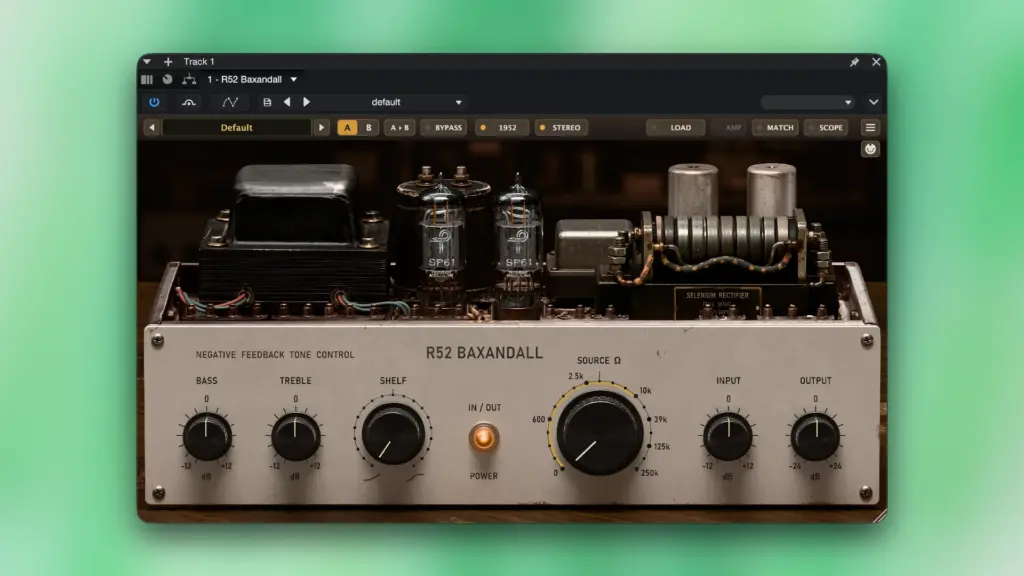
These three options can produce noticeably different results. The 1952 version is the closest to the original design. The 1957 version has a different tone, while the 1957 ALT version gives you another variation for experimenting with sound.
One of the most interesting things about R52 is how the Bass and Treble controls work together. They are not completely separate controls. Changing one can affect the overall response of the other. This means you shouldn’t expect R52 to behave exactly like a modern EQ where every frequency setting can be controlled independently.
R52 is better suited to broad changes. For example, if a vocal sounds a little thin, you can use the Bass control to add body. If it sounds dull, the Treble control can add brightness. You can then adjust the input level to change how strongly the valve part of the plugin responds. This makes the plugin useful when you want to change the overall character of a sound rather than fix one small frequency problem.
R52 also includes a SOURCE control. This changes the way the signal interacts with the modeled circuit. You don’t need to understand the electrical details to use it. Start with the default setting and change it only when you’re looking for a different character.
The LOAD and AMP controls work in a similar way. They let you change how the modeled amplifier and speaker section behave. These controls make R52 more flexible, but they also mean there are more settings to explore than you would find on a basic EQ. For everyday mixing, you don’t need to change every control.
A simple approach is to start with the 1952 setting, make a small Bass or Treble adjustment, and compare it with the original sound. If you like the general character, try the 1957 setting and see which version works better for the track.
R52 can be used on vocals, guitars, bass, drums, keyboards, synthesizers, individual instruments, mix buses, and even a complete master. It can also be useful for sound design because the different circuit settings can change the character of a sound.
However, R52 isn’t a replacement for a detailed EQ. If you need to remove a harsh frequency, reduce a narrow resonance, or make a very specific frequency adjustment, a normal parametric EQ will usually be easier and faster. R52 is more about the overall tone.
The plugin also supports stereo, Mid, Side, Left, and Right processing. This gives you more options when working with stereo tracks and mixes. Pulsar Modular lists latency of 91 samples at 44.1 and 48 kHz and 71 samples at 88.2 and 96 kHz. At 176.4 and 192 kHz, the listed latency is zero samples.

For normal mixing, this shouldn’t be a major problem. If you’re recording vocals or instruments through the plugin in real time, however, it’s worth checking the latency in your DAW first. R52 also uses automatic oversampling. There isn’t a separate quality setting that you need to adjust.
The plugin uses its own preset format. On Mac, R52 stores presets in:
/Users/Shared/Pulsar Modular/R52 Baxandall/Presets
Overall, R52 is aimed at people who want more than a basic Bass and Treble EQ. Its main attraction is the way it changes the character of a sound while making broad tonal adjustments.
Features of Pulsar Modular R52 Baxandall for Mac
- Works with popular DAWs including Ableton Live, Logic Pro, FL Studio, and Pro Tools
- Based on Peter Baxandall’s 1952 tone-control design
- Includes three circuit options
- 1952 version uses the SP61 valve
- 1957 version uses the ECC81 valve
- 1957 ALT combines the 1957 design with the SP61 valve
- Bass and Treble controls
- Bass and Treble affect each other as you make adjustments
- SOURCE control
- LOAD control
- AMP section
- Stereo processing
- Mid and Side processing
- Left and Right channel processing
- Works with mono and larger channel setups
- Visual SCOPE display
- Automatic oversampling
- 64-bit processing
- Automatic latency compensation
- Preset support
- Dedicated Mac preset folder
- Up to two computer activations
Technical Details:
- Software Name: Pulsar Modular R52 Baxandall MacOS
- Software File Name: Pulsar Modular R52 Baxandall 1.0.3.dmg
- Version: 0.3
- File Size: 127 MB
- File Extension: DMG
- License Type: Premium
- Developer: Pulsar Modular
System Requirements
- Operating System: macOS 10.10 or later
- Processor: Apple Silicon (M1, M2, M3, M4, M5) or Intel Core 64-bit
- RAM: 4 GB minimum, 8 GB recommended
- Storage: 200 MB free disk space
Best Alternatives to Pulsar Modular R52 Baxandall for Mac
There are several alternatives to R52, but each one is aimed at a slightly different type of work.
FabFilter Pro-Q 4 is a better choice if you want detailed control over individual frequencies. It is useful for fixing harsh sounds, removing unwanted frequencies, and making very precise EQ changes.
Waves PuigTec EQs are worth considering if you want broad EQ changes with a classic hardware-inspired sound. They are more focused on the familiar hardware EQ experience than R52’s recreation of the Baxandall circuit.
UAD Pultec EQ Collection is another option for broad tonal changes. Pultec-style EQs are widely used for shaping bass and treble, but they are based on a different design from R52.
Softube EQ plugins are also worth looking at if your main goal is an analog-style sound with a simple mixing workflow.
TDR SlickEQ is a good option if you want a straightforward EQ for general mixing without the extra controls found in R52.
The choice depends on what you need If you want to fix a specific frequency, a detailed EQ such as Pro-Q 4 makes more sense. If you want to change the overall character of a vocal, guitar, bass, synth, or mix, R52 is a different type of tool and is worth trying.
Pulsar Modular R52 Baxandall 1.0.3 for Mac Free Download
Click the button below to download Pulsar Modular R52 Baxandall 2026 for Mac latest full version setup free. It is a complete standalone installer for macOS with a single-click download link.