 AllMacWorld MAC Apps One Click Away
Download Wizard 2 v2.0.20 for Mac free latest full version standalone setup. Wizard 2026 for MacOS is an application that makes statistics and data analysis accessible to everyone: from students and teachers to professionals in marketing, medicine, and business.
Wizard 2026 for Mac Review
Wizard 2 is a statistical analysis application designed for users who want to work with data through a graphical interface rather than writing statistical code. It is particularly relevant to students, researchers, educators, and analysts who use a Mac and need to perform common statistical calculations without building their workflow around R or Python. You can also download Prism for Mac
The main attraction of Wizard 2 is its approach to statistical analysis. Instead of requiring users to remember programming syntax, the application provides an environment where data can be entered or imported, variables can be selected, and statistical procedures can be performed through the interface.
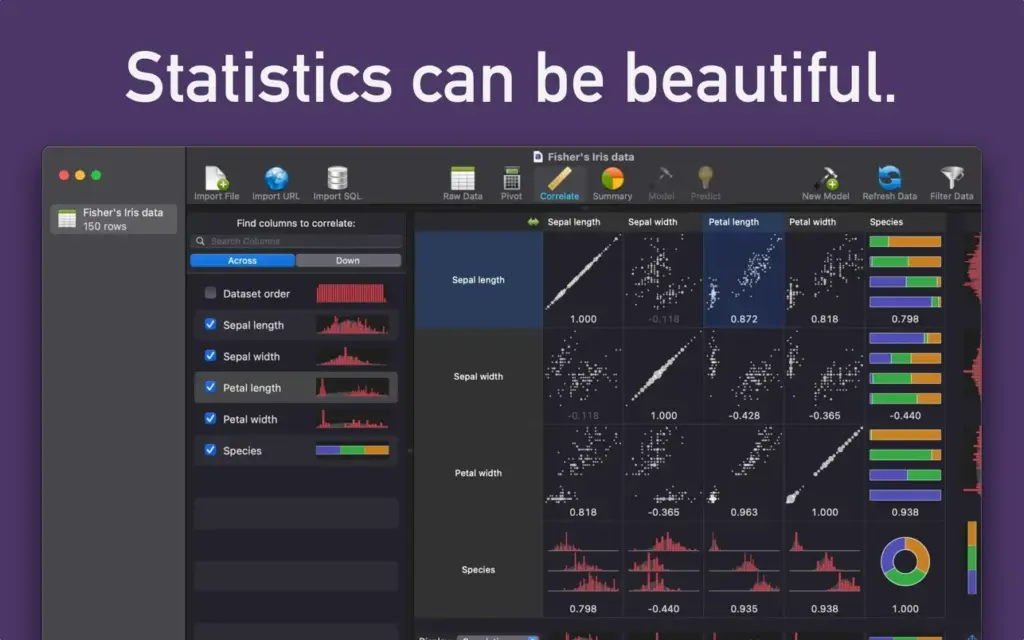
For someone learning statistics, this can make the practical side of data analysis much less intimidating. You can concentrate on understanding why a particular test is appropriate instead of spending time learning programming syntax.
The interface is also useful for exploratory analysis. Before choosing a statistical test, researchers should understand the data they are working with. Looking at distributions, summary statistics, relationships between variables, and unusual observations can reveal problems that may not be obvious from a spreadsheet alone.
This is where a graphical statistics application can be convenient. A researcher can move from the dataset to an initial analysis without creating a complete programming environment.
However, Wizard 2 should not be treated as a replacement for statistical knowledge. Selecting a test because it appears in a menu does not make the test appropriate. The researcher still needs to understand the study design, variable types, assumptions, sample size, missing observations, and interpretation of the results. This distinction is particularly important for academic research.
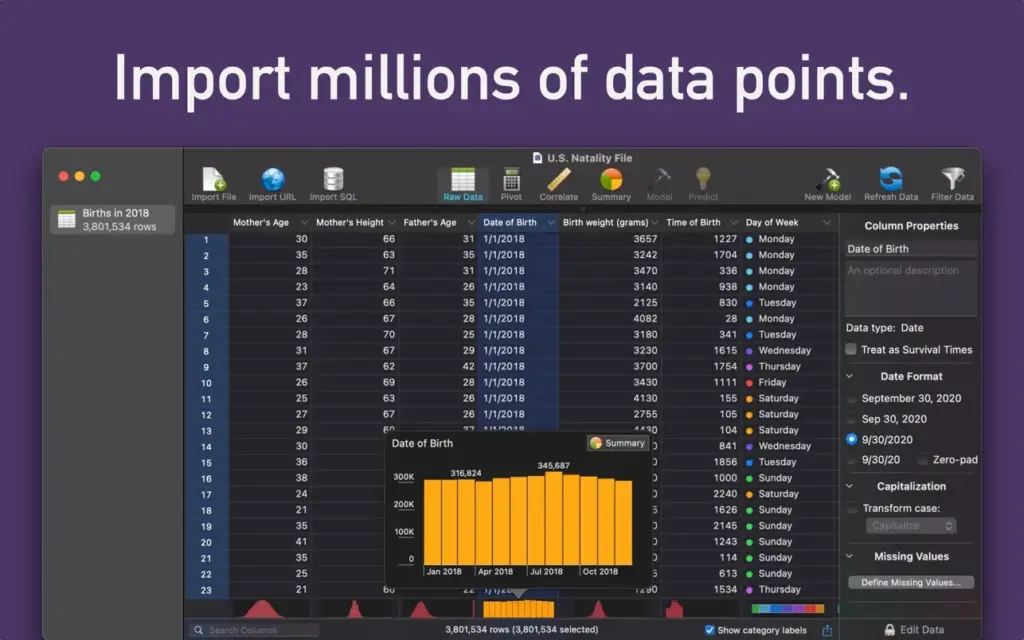
For example, if two groups need to be compared, the correct method depends on how the observations were collected. Independent groups, paired observations, categorical outcomes, continuous measurements, and repeated measurements can require different approaches. Wizard can perform the calculation, but the researcher must decide whether the calculation answers the actual research question.
The same applies to p-values. A statistically significant result doesn’t automatically mean that an effect is large or practically important. A good analysis should also consider effect size, uncertainty, confidence intervals, sample size, and the context in which the data were collected.
Wizard 2 is therefore best viewed as a statistical tool rather than a statistical decision-maker.
For students, this can be a useful distinction. Software that hides programming complexity can make it easier to learn the mechanics of statistical analysis, but students should still learn the reasoning behind the methods they use.
For experienced researchers, Wizard can be convenient when the required analysis falls within its supported procedures. It can be particularly useful for smaller datasets and straightforward analytical tasks where writing a complete statistical script would add unnecessary overhead.
There is a trade-off, though. Programming-based environments such as R and Python provide considerably more flexibility. They allow analysts to automate repetitive tasks, create reproducible scripts, build custom workflows, work with specialized statistical packages, and connect analysis with other data-processing systems.
That doesn’t make Wizard inferior. It simply means the applications serve different types of users and workflows.
Another consideration is reproducibility. When an analysis is performed through a graphical interface, researchers should keep careful records of the data preparation, statistical procedure, assumptions, exclusions, and other decisions that produced the final result. A research project shouldn’t depend on remembering which buttons were clicked several months earlier.
Overall, Wizard 2 has a clear appeal for Mac users who want an approachable environment for statistical analysis without immediately learning a programming language. Its usefulness is greatest when the analysis is reasonably standard and the user understands the statistical method being applied.
Features of Wizard 2 for Mac
- Graphical environment for statistical analysis
- Designed to reduce the need for statistical programming
- Suitable for students learning statistical methods
- Useful for researchers and analysts working with structured datasets
- Supports common statistical analysis workflows
- Provides tools for examining and analyzing datasets
- Useful for descriptive statistical analysis
- Can be used for hypothesis-testing workflows
- Supports statistical relationships such as correlation
- Provides access to common comparison and modeling procedures
- Includes graphical approaches for understanding data
- Allows users to work with variables without constructing statistical code for every operation
- Can be useful for exploratory data analysis
- More approachable for beginners than command-line statistical environments
- Suitable for users who prefer a point-and-click workflow
- Can complement more advanced tools such as R and Python
- Useful for relatively straightforward statistical projects
- Provides a Mac-oriented environment for users who prefer native desktop software
- Can reduce the initial technical barrier associated with statistical programming
Technical Details:
- Software Name: Wizard 2 MacOS
- Software File Name: Wizard 2 v2.0.20.dmg
- Version: 2.0.20
- File Size: 8 MB
- File Extension: DMG
- License Type: Premium
- Developer: Evan Miller
System Requirements
- Operating System: macOS 10.10 or later
- Processor: Apple Silicon (M1, M2, M3, M4, M5) or Intel Core 64-bit
- RAM: 8 GB minimum, 16 GB recommended
- Storage: 500 MB free disk space
Best Alternatives to Wizard 2 for Mac
R: R is one of the strongest alternatives for users who want a much deeper statistical environment. It is free, open-source, and supported by a large ecosystem of packages covering statistical modeling, visualization, data manipulation, machine learning, and specialized research methods. The major drawback is the learning curve. R requires users to work with code, although applications such as Posit RStudio provide a more convenient development environment. R is a better choice than Wizard when reproducibility, automation, advanced statistical modeling, or highly customized analysis is important.
Python: Python is another powerful option for statistical and data analysis. Libraries such as pandas, NumPy, SciPy, statsmodels, and matplotlib allow users to build sophisticated data workflows. Python has an advantage when statistical analysis needs to be combined with automation, software development, machine learning, data engineering, or other programming tasks. For someone who only needs a few standard statistical tests, however, Python can introduce more complexity than necessary.
SPSS IBM SPSS Statistics is a long-established statistical application with a graphical interface. It is widely used in academic research, particularly in areas such as psychology, education, social sciences, and health-related research. SPSS is attractive to users who want extensive statistical functionality without having to write traditional programming code. Its main disadvantages compared with free alternatives include licensing costs and the fact that users remain dependent on a commercial software ecosystem.
JASP: JASP is a free statistical application with a graphical interface and is particularly popular among students and researchers. It provides a relatively accessible way to perform common statistical analyses while also supporting modern statistical workflows, including frequentist and Bayesian approaches. For someone looking for a free graphical alternative to Wizard, JASP is worth considering.
Jamovi: jamovi is another user-friendly statistical platform aimed at people who want to perform statistical analysis without extensive programming. Its interface is familiar to users coming from spreadsheet-style applications, while its module-based architecture allows additional statistical functionality to be added. jamovi can be a strong choice for students, educators, and researchers who want a modern graphical statistics environment.
GraphPad Prism: GraphPad Prism is particularly well known in scientific and biomedical research. It combines statistical analysis with data visualization and is designed around workflows commonly encountered in experimental research. Its interface can be easier to approach than a programming environment, but it is a commercial product. Prism is worth considering when high-quality scientific graphs and research-oriented statistical workflows are more important than having a general-purpose programming environment.
Wizard 2 v2.0.20 for Mac Free Download
Click the button below to download Wizard 2026 for Mac latest full version setup free. It is a complete standalone installer for macOS with a single-click download link.